
Your clinic looks excellent in person. The treatment rooms are spotless, your practitioners know what they're doing, and patients who do come in often stay loyal. But online, you're buried under directories, larger chains, and weaker clinics with better search visibility. The phone is quieter than it should be, and your best treatments aren't the pages people are finding.
That problem usually isn't “SEO” in the abstract. It's a visibility and trust problem. Prospective patients in the UK don't discover aesthetic clinics the way they used to. They search, compare, read reviews, scan treatment pages, check your location, and decide whether your clinic feels credible enough to contact.
Most advice on SEO for aesthetic clinics is too generic to be useful. It tells you to “use keywords” and “write blogs” without addressing the parts that determine whether you win bookings: local intent, compliant treatment copy, trust signals, and the growing impact of AI-generated answers in search. If you get those wrong, traffic won't save you. If you get them right, you can outperform bigger competitors without playing a volume game.
Table of Contents
- Why Your Clinic Is Invisible Online and How to Fix It
- Mastering Local SEO to Win Nearby Patients
- Building Service Pages That Convert and Comply
- A Content Strategy That Answers Real Patient Questions
- The Technical Health Check Your Clinic Website Needs
- Measuring What Matters and Planning for Growth
- Frequently Asked Questions About Clinic SEO
Why Your Clinic Is Invisible Online and How to Fix It
A common pattern looks like this. A clinic owner invests in interiors, machines, training, and patient experience. The website goes live, maybe with a few treatment pages and some nice photography. Then months pass, and the only enquiries coming through search are patchy, low quality, or inconsistent.
The reason is usually simple. Google doesn't rank clinics because the branding feels premium. It ranks clinics that send clearer local, topical, and trust signals than the alternatives. If your website has one generic “Treatments” page, your Google Business Profile is half-finished, and your reviews are unmanaged, you've told search engines almost nothing useful.
That creates a bad commercial loop:
- You stay hard to find for patients searching by treatment and town.
- You look less established than clinics with stronger profiles and fresher reviews.
- You lose trust before contact because your digital footprint feels thin.
- You rely too heavily on referrals instead of building a repeatable enquiry channel.
Your clinic doesn't need more vague marketing activity. It needs a tighter digital footprint that matches how UK patients actually choose providers.
Smaller independent clinics can win this. In fact, they often should win. You're closer to your patients, you know the objections they raise in consultation, and you can publish more specific content than a chain using generic copy across multiple branches.
The fix is practical. Own local search first. Build individual treatment pages that answer decision-stage questions. Publish content that reflects what patients ask before booking. Remove friction from the mobile experience. Then track leads properly so you know which pages are producing commercial value.
That's what turns SEO for aesthetic clinics from a vague marketing line item into a booking system.
Mastering Local SEO to Win Nearby Patients
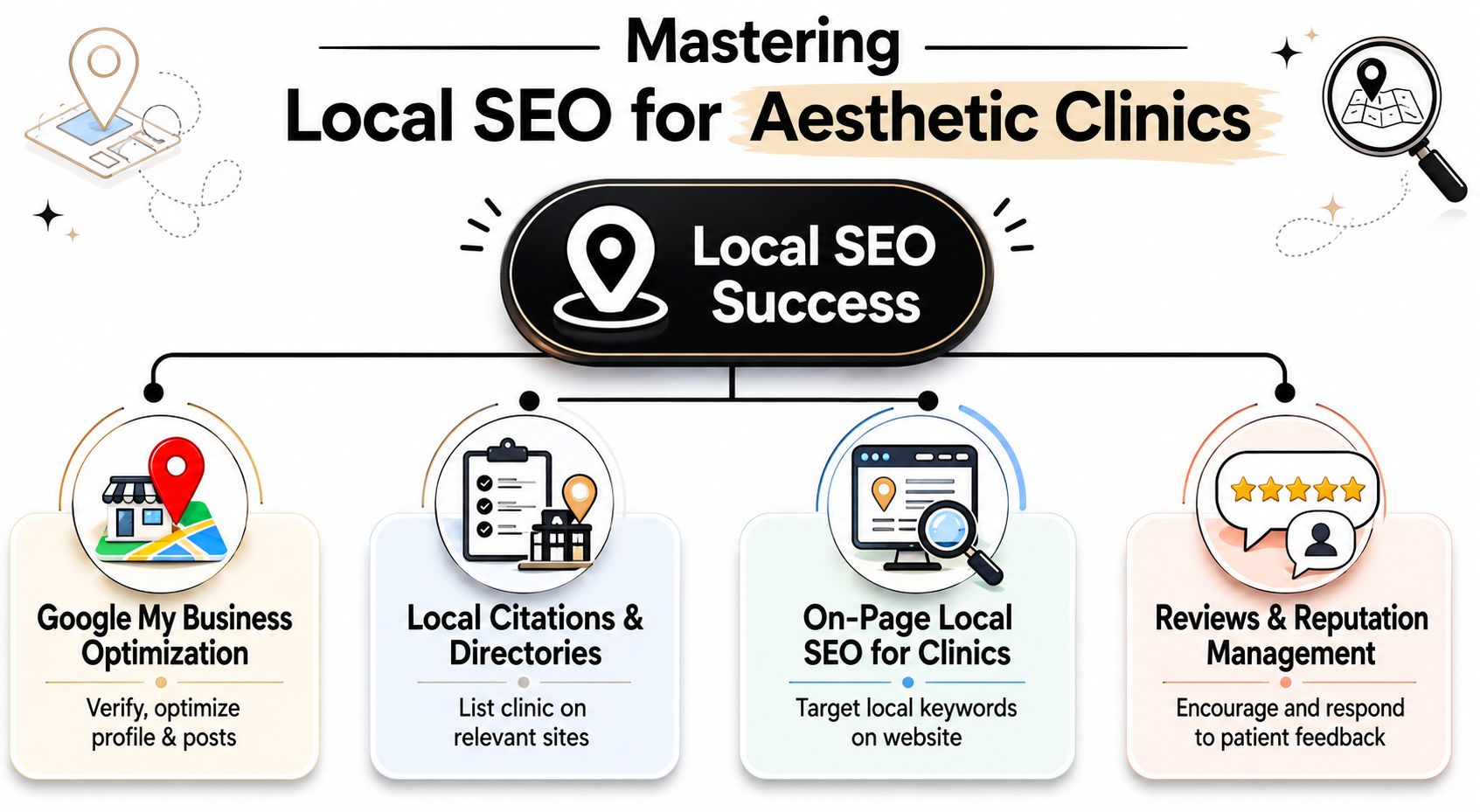
A patient searches “lip filler Leeds” at 8:15pm, compares three clinics on the map, taps two profiles, then books a consultation with the one that looks active, local, and credible. That decision often happens before they visit a website. If your clinic is weak in local search, you lose the booking at the shortlist stage.
Google has reported that nearby searches on smartphones often lead to a business visit within a day, and a meaningful share lead to a purchase, in its consumer behaviour research on how people use local search. For aesthetic clinics, that makes local SEO a booking channel, not a side task.
Make your Google Business Profile do its job
Your Google Business Profile needs to answer four questions fast. Who are you? What treatments do you offer? Where are you? Why should a patient trust you enough to enquire?
Get the basics right first:
Complete every field that affects trust
Add your clinic name, full address, local phone number, website, opening hours, appointment link, and service categories. Missing details reduce visibility and make the profile look neglected.List real treatments in plain English
Use service names patients search for, such as anti-wrinkle consultations, lip filler, skin booster consultations, or laser hair removal. Branded internal terminology helps no one.Upload current clinic photos
Show the exterior, reception, treatment rooms, and practitioners. Stock imagery weakens confidence. Real photos help patients recognise the clinic and lower no-show risk.Use the Q&A section properly
Add practical questions about parking, consultations, patch tests, accessibility, and how to book. Keep answers factual. Do not turn this into sales copy.Publish updates that support trust
Post clinic news, opening changes, practitioner updates, and educational content. Avoid promotional wording that pushes into risky territory, especially around prescription-only treatments.
If you want a wider view of how local visibility fits into a full acquisition system, this overview of SEO marketing services for clinics shows the main moving parts.
A half-complete profile does not “sort itself out” over time. It suppresses trust immediately.
Tighten local relevance on your site
Your website has to confirm what your profile claims. Start with your contact page, footer, and key service pages. Your clinic name, address, and phone number must match exactly across the site and listings. Exact means exact.
Then fix the pages that support local intent:
| Page type | What it should do |
|---|---|
| Contact page | Confirm address, opening hours, map, parking, and booking route |
| Core treatment pages | Target treatment intent clearly and reference the clinic location naturally |
| About or team page | Show who treats patients and why the clinic is credible |
| Location pages | Cover genuine branch or area intent, not spun copies with swapped town names |
Do not churn out thin pages for every nearby town if you do not have a real reason to rank there. That tactic is dated, easy to spot, and weak from both a user and compliance perspective. One strong page for a treatment in your actual service area beats ten near-duplicate location pages every time.
Reviews matter because they change conversion rates
Reviews influence both rankings and patient confidence, but only if you handle them like an operating process.
Ask at the right point. After the consultation alone is too early for many treatments. Weeks after treatment is too late. Build a review request into your patient journey at the point where the experience is clear and fresh. Use SMS or email. Keep the ask simple. Make leaving feedback easy on mobile.
Then respond properly. Thank the patient, stay professional, and never discuss treatment details in public. This is especially important in the UK, where clinics need to balance visibility with patient confidentiality and ASA-sensitive wording. Generic SEO advice rarely covers that. It should.
Focus on the signals that win the local pack
For aesthetic clinics, local SEO usually comes down to a short list of signals executed well and kept current:
- A complete and active Google Business Profile
- Consistent clinic details across your website and directories
- Strong treatment pages with clear local relevance
- A steady flow of recent, authentic reviews
- Clear evidence of a real clinic, real team, and real location
That is how you win nearby patients. Not with generic “content marketing” activity. With a local presence that looks trustworthy the moment someone is ready to book.
Building Service Pages That Convert and Comply
A treatment page should do more than rank. It should help a patient decide whether your clinic feels safe, credible, and worth contacting. Most don't.
Why most treatment pages fail
Too many clinic websites use thin pages stuffed with treatment names, generic promises, and stock phrasing. They mention the procedure, repeat the town name a few times, and add a contact form at the bottom. That isn't persuasive. It's forgettable.
Worse, some pages push too hard. They make outcome-heavy claims, gloss over suitability, or imply certainty where a clinician should be more precise. Aesthetic medicine is trust-sensitive. If the page sounds promotional before it sounds credible, patients notice.
A UK-specific gap in clinic SEO advice is how to improve search visibility without creating regulatory risk. Existing guides often miss how to frame claims around injectables and outcomes in a way that stays search-friendly and compliant, even though that's where many clinics lose trust and conversions, as discussed in this SEO guidance for clinics in regulated categories.
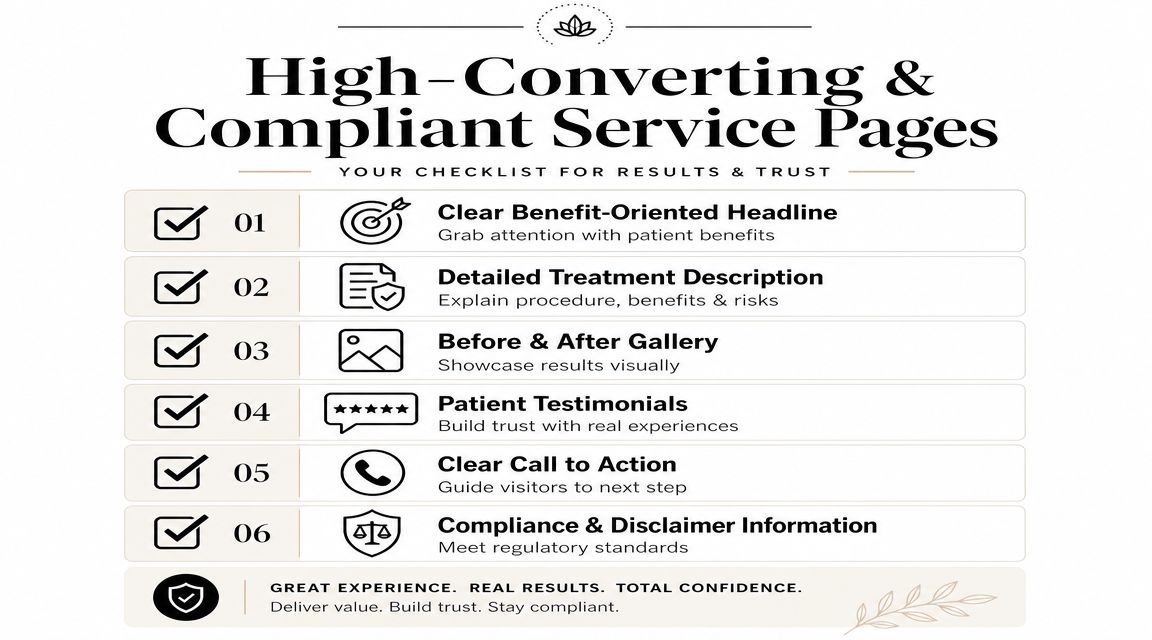
What a strong treatment page should include
Use one dedicated page per treatment and location intent where relevant. Not one giant services page.
A good page usually includes:
- A clear headline that names the treatment and location naturally.
- A plain-English explanation of what the treatment is and what it's intended to address.
- Suitability guidance so patients can self-qualify before they enquire.
- What the appointment process involves, including consultation and aftercare expectations.
- Pricing context where appropriate, or a clear explanation of what affects price.
- Practitioner credentials that show who delivers or oversees treatment.
- Frequently asked questions covering pain, downtime, suitability, and next steps.
- A direct call to action such as booking a consultation or requesting advice.
If your pages need rewriting, strong website content support for service-led businesses should prioritise clarity, trust, and conversion intent over keyword stuffing.
Here's the test. If a patient lands on the page without knowing your clinic, will they leave with fewer doubts than they arrived with? If not, the page needs work.
A useful media format can help when the treatment needs explanation. For example:
How to stay persuasive without becoming risky
You don't need to write timid copy. You need to write precise copy.
That means:
Describe process, not hype
Explain consultation, treatment approach, practitioner oversight, and aftercare rather than leaning on sweeping promises.Answer objections directly
Patients want to know whether a treatment is suitable, what recovery is like, and when they can return to normal activity.Use evidence from your clinic
Clinician credentials, treatment philosophy, real FAQs, and carefully handled patient proof carry more weight than inflated claims.
A strong page sounds like a competent consultation, not an advert.
Compliant pages often convert better because they reduce anxiety instead of trying to overpower it. In aesthetic care, trust isn't decoration. It is the conversion mechanism.
A Content Strategy That Answers Real Patient Questions
Most clinics publish content backwards. They start with broad topics because they think broader means more traffic. It usually means weaker intent.
The better approach is to publish around the questions patients ask before they're ready to enquire. Those questions reveal hesitation, comparison behaviour, and commercial intent. They also map neatly to how search is changing.

Write for the consultation questions you hear every week
Start with your front desk, clinicians, and consultation notes. What do patients keep asking before booking?
You'll usually hear variations on:
- Downtime questions such as whether they can return to work quickly
- Pain and comfort concerns around the treatment experience
- Suitability questions about skin type, age, goals, or previous treatment history
- Comparison questions between two procedures
- Price framing questions about what affects cost
Those are not “blog ideas”. They are buying signals.
Turn them into focused articles, FAQ sections, and supporting content linked from your main treatment pages. Keep each piece anchored in your clinic's actual approach. If your clinician assesses suitability in a specific way, say so. If certain treatments are more popular in your area, reflect that local context.
Build content for AI Overviews and zero-click search
Search results increasingly answer questions before a user clicks through. That's especially relevant in aesthetics, where searches often take the form of direct questions about suitability, recovery, pain, and price.
Most clinic SEO advice still stops at keywords, location pages, and backlinks. It doesn't explain how to stay visible when Google summarises the answer itself. A better strategy is to target decision-stage questions using clinic-specific evidence and clinician credentials so your content remains worth clicking, as explained in this guide to SEO for aesthetic clinics and AI-led search behaviour.
Use this structure:
| Content type | Best use |
|---|---|
| Treatment FAQs | Handle practical objections on key service pages |
| Comparison articles | Help patients choose between similar options |
| Recovery guides | Capture decision-stage searches around downtime |
| Suitability content | Filter poor-fit leads and build trust with better-fit ones |
If your content only says what the treatment is, AI can summarise it. If your content shows how your clinic evaluates, delivers, and supports that treatment, patients still have a reason to click.
That's the shift many clinics miss. You're no longer just competing with nearby clinics. You're competing with search interfaces that compress basic information into the results page. To keep organic traffic useful, publish content that carries local relevance, clinical specificity, and obvious next steps.
The Technical Health Check Your Clinic Website Needs
A slow or awkward website cancels out good marketing. People won't say, “This clinic's page speed is poor.” They'll just leave.
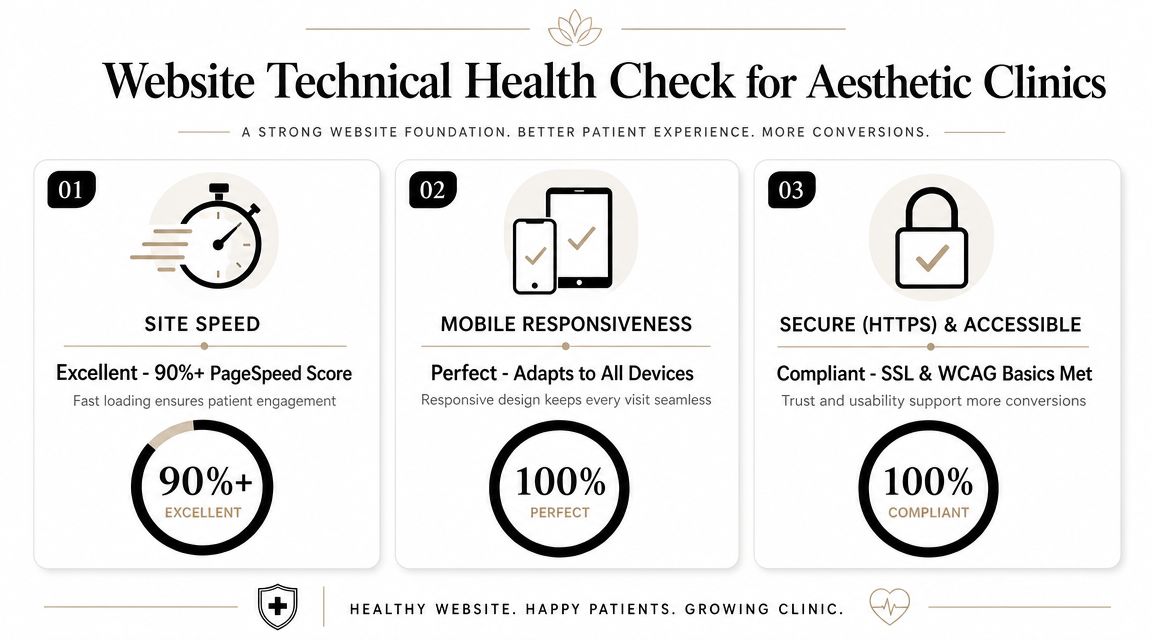
With 98% of UK adults online in 2024 and 95% using the internet daily, a clinic's digital presence is the default discovery path for patients. In that environment, a fast, trustworthy website matters because patients judge clinics through search results, reviews, and service pages before they ever make contact, as noted in this UK aesthetics SEO overview.
Speed is a conversion issue first
Heavy image files, autoplay media, bloated themes, and cluttered scripts are common on clinic websites. The result is a page that looks polished in a design mock-up and feels sluggish on a phone.
Check the basics:
- Homepage load feel on mobile data, not just office Wi-Fi
- Treatment page speed because these pages often carry the heaviest imagery
- Form performance so enquiry actions don't lag or fail
- Image handling especially before-and-after galleries
If your developer shrugs this off as minor, push back. Speed affects trust. A delayed page feels less professional, particularly in a medical-adjacent category.
Mobile experience and structure matter more than design flourishes
Most clinic traffic is likely to come from phones, so mobile isn't a resized desktop site. It's the primary experience.
Review these points manually:
- Can someone tap to call easily
- Is the main booking action obvious without scrolling too far
- Do forms feel manageable on a small screen
- Are service pages readable without pinching and zooming
- Does the site feel secure and current
Your platform choice also affects how easily your team can maintain speed, content, and SEO hygiene over time. If you're weighing rebuild options, this comparison of WordPress, Shopify and Webflow in 2026 helps frame the trade-offs.
What to ask your developer to review
Don't ask for “better technical SEO”. That's too vague. Ask for specific checks:
- Schema markup for local business, services, and relevant FAQs
- Indexing review to make sure important treatment and location pages are crawlable
- Broken links and redirects especially after past redesigns
- Secure browsing basics including HTTPS and a clean browser experience
- Page template consistency so titles, headings, and metadata aren't chaotic
A clinic website should feel frictionless, stable, and trustworthy. If it doesn't, your rankings and conversions both suffer.
Measuring What Matters and Planning for Growth
A common clinic scenario looks like this. Traffic is up, rankings look better, the agency report sounds positive, and the diary is still patchy. That usually means you are measuring the wrong things.
SEO for aesthetic clinics should be judged by commercial outcomes. In the UK, that also means checking that the pages attracting attention are the same pages that can win trust without straying into risky claims. More visibility is useless if it lands on weak pages, vague treatment content, or copy that creates compliance problems.
Track booking intent, not vanity metrics
Start with actions that show real patient intent:
- Contact form submissions
- Phone call clicks from mobile
- Online booking requests
- Direction requests from local search
- Clicks from key treatment pages into consultation actions
Use Google Analytics 4 and Google Search Console together. GA4 shows which pages assist enquiries and where users abandon the journey. Search Console shows which queries and pages are earning visibility. Put those two views together and you can see which treatments bring in serious prospects, which pages attract low-intent traffic, and which opportunities deserve more budget, content time, or page improvements.
Review this monthly. Not once a quarter when the problem has already cost you bookings.
Ask which pages drove consultation intent and booked-patient actions. That is the scorecard.
Build a reporting view your front desk can understand
If a report needs an SEO specialist to translate it, it is too complicated.
Your clinic needs a short list of numbers tied to revenue potential:
| Metric | Why it matters |
|---|---|
| Enquiries by treatment page | Shows which services attract intent, not just clicks |
| Call clicks and booking actions | Reveals whether mobile visitors are ready to act |
| Google Business Profile actions | Shows local search demand turning into contact |
| Top converting search queries | Helps you expand pages that bring the right patients |
| Drop-off points on enquiry paths | Shows where the site is losing warm prospects |
That reporting format also helps with compliance. If a page gets traffic but poor enquiry rates, the answer is not always “add more SEO copy”. Often the page needs clearer treatment information, better next steps, stronger trust signals, or tighter wording that informs without overpromising.
A simple ninety-day operating rhythm
Growth comes from a repeatable operating rhythm, not random bursts of blog posts.
| Timeframe | Priority |
|---|---|
| Month one | Audit tracking, check conversion paths, and fix weak money pages |
| Month two | Improve the pages that earn impressions but fail to produce enquiries |
| Month three | Expand into adjacent treatment terms, refine local intent pages, and review booked-lead quality |
Keep the monthly review tight. Look at three questions only:
- Which pages brought in relevant organic visitors
- Which pages produced enquiry actions
- Which pages attracted attention but failed to move users forward
Then act on what you find. Improve pages with visibility but weak conversion. Expand topics around treatments that already produce good leads. Cut time spent chasing broad keywords that look impressive in a report but never turn into consultations.
That is how clinics grow search visibility without losing focus. You build around treatments, locations, and questions that produce booked demand, then improve the patient journey until more of that demand converts.
Frequently Asked Questions About Clinic SEO
Clinic owners usually ask sensible commercial questions about SEO. Here are direct answers.
| Question | Answer |
|---|---|
| How long does SEO for aesthetic clinics take to work? | Local fixes can improve visibility earlier than broader content work, but SEO isn't instant. Expect it to compound when your local presence, treatment pages, and tracking are all aligned. |
| Should I focus on Google Business Profile or my website first? | Start with your Google Business Profile and local consistency if those are weak. Then improve your main treatment pages. You need both, but local visibility often creates the earliest commercial lift. |
| Do I need a page for every treatment? | Yes, in most cases. If a treatment matters commercially, it deserves its own page with clear information, suitability guidance, and a direct next step. |
| Can I write my own clinic content? | Yes, if you know the treatments well and write clearly. But content should still be reviewed carefully for accuracy, tone, and compliance. Generic AI copy won't be enough. |
| Are blog posts still worth doing? | Yes, if they answer real patient questions and support decision-making. No, if they're generic lifestyle filler with no link to your treatments or location. |
| What matters more, traffic or enquiries? | Enquiries. A smaller volume of the right visitors is more valuable than broad traffic that never converts. |
| Should I hire a specialist agency? | If your team can't maintain local SEO, content quality, technical upkeep, and reporting consistently, specialist support usually makes sense. The key is choosing people who understand trust-sensitive marketing, not just rankings. |
If your clinic needs a sharper digital presence, BPE Digital helps UK businesses build fast, conversion-focused websites and growth systems that prioritise enquiries, revenue, and search visibility. Their work is senior-led, custom-built, and designed to support the parts of SEO that actually move bookings, from local search and content to technical performance and ongoing optimisation.