What Is Brand Positioning
What is brand positioning, and why it matters for UK businesses.
How to claim a clear, defensible space in your customer’s mind — and turn that decision into better enquiries, stronger pricing, and a website that pulls its weight.
Brand positioning is the deliberate process of claiming a clear place in your customer’s mind, and in the UK that matters because 64% of consumers say a company’s stance on social or environmental issues would influence whether they buy, while 49% are more likely to buy from brands aligned with their values. In practice, that means positioning isn’t a slogan or a logo refresh. It’s the reason someone lands on your website, understands why you’re different, and decides you’re worth contacting.
A lot of business owners arrive at this question when their marketing feels busy but thin. The website looks decent, the social posts are going out, Google Ads are running, yet the enquiries aren’t quite right. You get price shoppers, weak-fit leads, or people who still ask what makes you different after reading your homepage.
That usually points to a positioning problem.
Brand positioning is the deliberate process of carving out a specific, memorable, and desirable spot for your brand in your ideal customer’s mind, so they choose you over competitors without a second thought. If branding is how you look and sound, positioning is what you stand for in the buyer’s mental shortlist. It’s the spot you want to own.
Picture a car park. If you don’t choose your space, you end up circling with everyone else, hoping for attention. Strong positioning picks a marked bay near the entrance and puts your name on it. The customer knows where to find you, and the reason you belong there.
What is brand positioning and why does it matter?
If your website says you offer “high quality service”, “expert solutions”, or “a customer-first approach”, you’re probably sounding like everyone else in your market. A clinic says it offers personalised treatments. A roofer says no job is too big or small. A bakery says everything is handmade with care. None of that is wrong. None of it positions the business either.
Brand positioning answers one commercial question: why should the right customer choose you over the alternatives they’re already considering?
That idea was formalised by Al Ries and Jack Trout in the early 1970s. Their central point still holds. Positioning is about what a brand owns in the prospect’s mind, not just what it says in advertising, as outlined in Harvard Business School Online’s summary of brand positioning statements.
What it looks like in real buying situations
A clear position reduces friction. When a buyer lands on your site, they shouldn’t have to work out whether you’re premium, affordable, fast, specialist, local, design-led, family-friendly, medically focused, or trade-oriented. You should make that obvious.
If you don’t, buyers fill the gap themselves. They compare you on price. They use lazy category shortcuts. They pick the competitor with the clearest message, even if your actual service is better.
Practical rule: If a customer has to read half your website to understand who you’re for, your positioning is too weak.
That’s why positioning matters commercially. It helps you attract better-fit enquiries, defend your pricing, and make each channel work harder. SEO, paid ads, social media, and referral traffic all convert better when the landing message is specific.
Why it matters more in the UK market
UK buyers don’t just choose on features. They also look at trust, values, and relevance. In the UK, 64% of consumers said a company’s stance on social or environmental issues would influence whether they bought from it, while 49% said they would be more likely to buy from brands aligned with their values, according to UK branding data highlighted by Made By Shape.
That doesn’t mean every SME needs a purpose campaign. It means buyers are looking for signals that help them decide whether a business feels right for them.
A good position gives those signals clearly:
- Who you serve: Not everyone. A defined customer with a recognisable problem.
- What you’re known for: Not ten things. One strong, defensible idea.
- Why people should believe you: Not empty claims. Evidence in the experience.
When positioning is strong, the website stops behaving like an online brochure and starts acting like a filter. It pulls in the right enquiries and effectively filters out the wrong ones. That’s usually good for revenue, even if it feels narrower on paper.
Positioning vs branding vs USP: what’s the difference?
These three terms get lumped together so often that many businesses spend money on the wrong problem. They think they need a new logo but they need a sharper market position. Or they think one standout feature is enough to define the entire brand.

The easiest way to separate them is the car park analogy.
The car park analogy
Brand positioning is the parking bay you want to own in the customer’s mind. It’s the labelled spot near the entrance. “The trusted local clinic for natural-looking treatments.” “The roofer homeowners call when they want clear communication and tidy work.” “The bakery known for small-batch pastries worth travelling for.”
Branding is the car itself. Its design, colour, finish, sound, and how it feels to sit in. In business terms, that’s your name, logo, typography, tone of voice, imagery, packaging, signage, and website design.
USP is one specific feature on the car that stands out. Maybe it’s fuel efficiency, boot space, or a reversing camera. In business terms, that might be same-day quotes, organic ingredients, evening appointments, or specialist accreditation.
| Term | What it does | What it is not |
|---|---|---|
| Positioning | Claims a clear mental space in the market | Not a visual style |
| Branding | Expresses the brand through design and communication | Not the strategy itself |
| USP | Highlights one attractive differentiator | Not a full market position |
How they work together
A business can have strong branding and weak positioning. You see this a lot. The site looks polished, the colours are sharp, the photography is expensive, but the message is generic. It feels nice and says very little.
A business can also have a decent USP and still lack positioning. “Open seven days a week” might help. But if five competitors also offer that, it won’t hold the whole brand together.
A logo can make you look established. A USP can make you sound interesting. Positioning makes you easier to choose.
That’s why identity work only lands properly when it follows strategy. If you’re reviewing your own visuals, copy, or tone, this broader view of branding and identity is useful. The important point is that design should express the position, not try to invent one after the fact.
The four pillars of a powerful brand position
A strong brand position gives your business a clear spot in the buyer’s mind, like getting the right space in a busy car park instead of circling with everyone else. For a UK small business, that clarity does not just tidy up the messaging. It usually leads to better enquiries, fewer price-led conversations, and a website that does more of the selling before anyone picks up the phone.
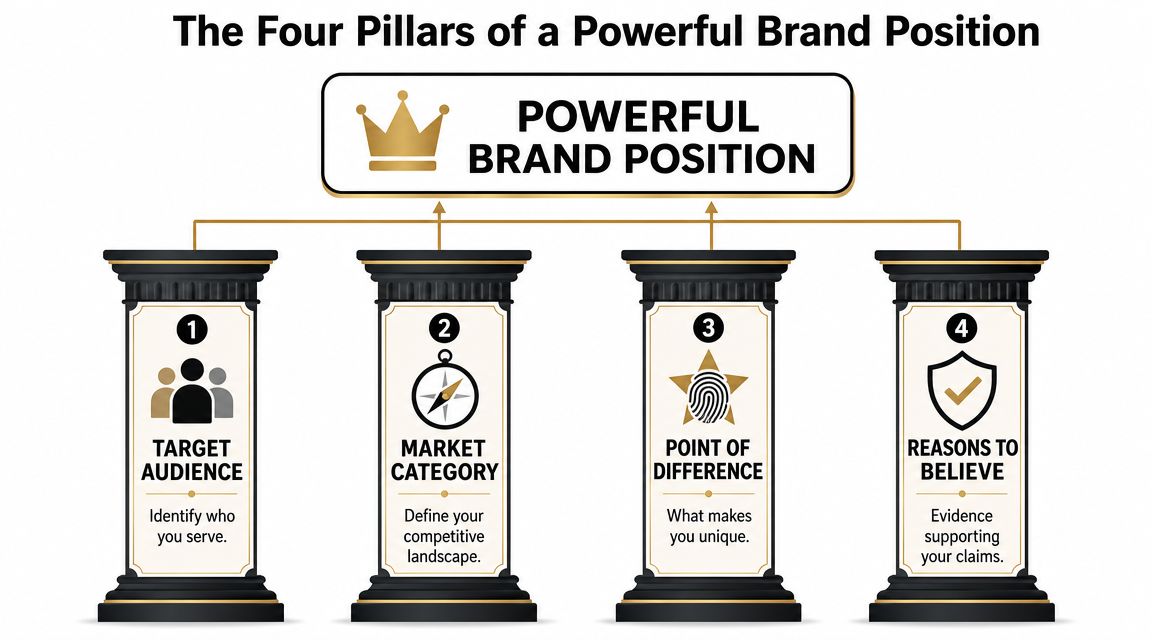
The four pillars are simple: target customer, category, difference, and proof. If one is weak, the whole position becomes harder to believe and harder to convert into revenue.
Target audience
Start with who you want more enquiries from.
Broad labels such as homeowners, women, or local businesses are too loose to guide a website or sales message. A useful audience definition includes context, need, and buying intent. It should also reflect the customers who are commercially attractive, not just easy to describe.
A Midlands aesthetics clinic might focus on working professionals who want subtle results and value medical credibility. A bakery might target customers ordering for birthdays, weddings, and other milestone events, where presentation and reliability matter more than price. A roofing firm might choose homeowners who want clear communication, dependable scheduling, and tidy work, not people collecting the cheapest quote from five tabs.
Good positioning includes a decision about who not to chase. That trade-off sharpens the message and usually improves lead quality.
Market category
The second pillar is the category you want buyers to place you in.
Customers compare you against what they think you are. Get the category wrong and even a strong service can look irrelevant or overpriced. A business describing itself too broadly often creates confusion, which weakens conversion on the page and in the sales call.
For example, an agency that says it does marketing, design, SEO, and social can sound capable but vague. An agency positioned as a conversion-focused web design studio for independent brands gives the buyer a clearer frame. A trades business that says roofing services is generic. Residential roofing and repair for homeowners who want straightforward advice creates a more useful comparison.
The category should help the buyer answer a basic question fast. What kind of solution is this, and is it for someone like me?
Point of difference
The third pillar is your main reason to be chosen.
Many businesses get muddy. They list every feature, every service, and every nice-sounding value, then wonder why none of it sticks. A sharper position usually comes from one central difference that matters to the buyer and can carry across the website, proposals, and sales conversations.
That difference might come from your process, specialist expertise, speed, service model, or the experience of working with you.
A few examples:
- For a clinic: natural-looking results delivered through a medically led consultation process
- For a bakery: celebration cakes that feel designed for the occasion, not standard templates with different icing
- For a trade firm: fast communication and reliable project handling from quote to completion
Use a simple test. If two nearby competitors could paste the same claim onto their homepage without stretching the truth, the difference is still too weak.
Reasons to believe
The fourth pillar is proof.
Positioning ceases to be a mere claim and begins to work commercially. Buyers are sceptical, especially online. They do not take premium, trusted, expert, or award-winning at face value anymore. They look for evidence, and your website often supplies that evidence before your team gets a chance to speak.
Proof can include reviews, case studies, credentials, before-and-after examples, guarantees, transparent pricing logic, and visible experience in the sector. It also includes the digital experience itself. If the site is slow, confusing, or thin on detail, the position loses credibility. If the site is quick, clear, and well structured, the position feels more believable before the enquiry form is even opened.
This is why website content that supports conversion matters so much. The words need backing from layout, usability, trust signals, and the path to enquiry.
A business that claims to be premium but hides reviews and loads slowly creates doubt. A business that claims to be expert-led and then shows qualifications, useful service pages, recent work, and a smooth enquiry journey gives the buyer a reason to act.
How to write a positioning statement, step by step
A positioning statement is an internal tool first. You don’t have to paste it word for word on your homepage. Its job is to keep your website, ads, social content, and sales language pointing in the same direction.
A simple version works well for most SMEs. Use this structure:
For [target customer], [brand] is the [market category] that [key benefit] because [reasons to believe].
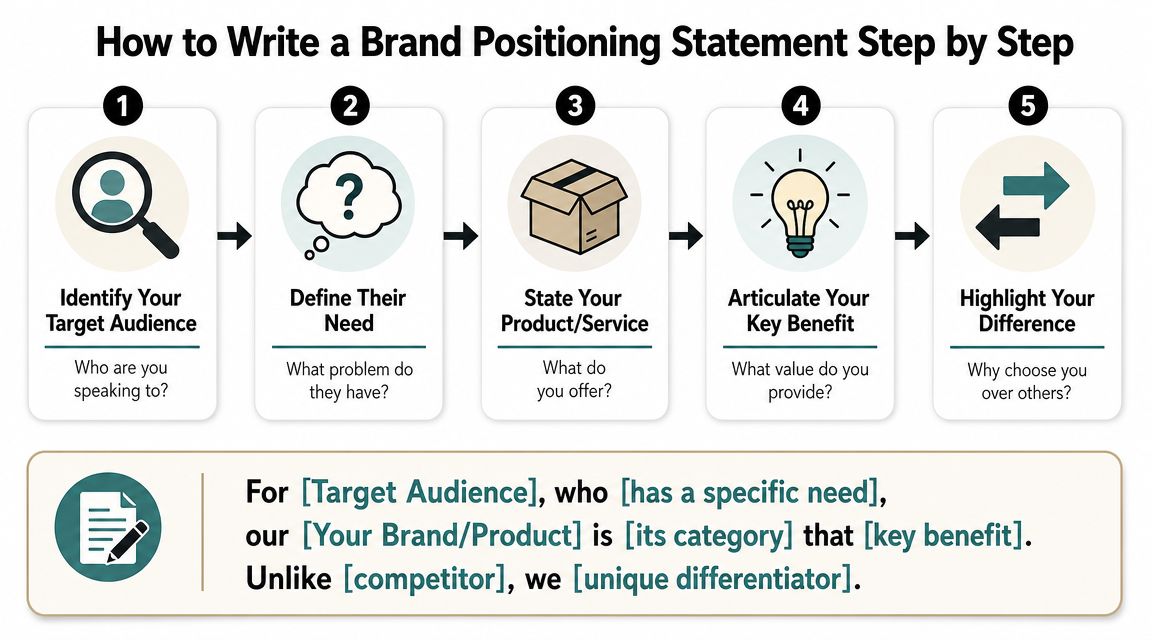
That’s not meant to sound poetic. It’s meant to force decisions. For example:
For busy professionals in Birmingham seeking subtle aesthetic treatments, [brand] is the medically led clinic that delivers natural-looking results with a calm, consultative experience because its practitioners show clear credentials, patient proof, and transparent treatment guidance.
That’s already more useful than “We are a leading clinic committed to excellence.”
Brand positioning examples for UK businesses
The fastest way to understand positioning is to compare a vague version with a sharper one. Below are three realistic UK business scenarios. None of these are case studies. They’re the sort of before-and-after shifts that happen when a business stops describing itself by category alone.
Aesthetic clinic
Before: “We are a professional aesthetics clinic in Birmingham offering a wide range of treatments.” There’s nothing offensive about that line. It just doesn’t do much. It could belong to almost any clinic.
After: “For busy Birmingham professionals who want subtle, confidence-boosting treatments, we’re the medically led clinic focused on natural-looking results and clear treatment guidance.”
That changes the whole website. The homepage headline becomes less about “aesthetic excellence” and more about safe, understated outcomes. The imagery should support calm, credible treatment rather than glam-first beauty tropes. The copy should explain consultations, practitioner credentials, and the logic behind treatment recommendations.
Artisan bakery
Before: “We are a family-run bakery producing fresh cakes, breads and pastries.” Again, accurate. Also forgettable.
After: “For customers who want memorable bakes for gatherings, gifting and special occasions, we’re the artisan bakery known for small-batch quality and designs that feel worth turning up for.”
That position is less about “freshly baked” and more about occasion value. The homepage should show celebration moments, signature products, and ordering clarity. The buyer isn’t just purchasing food. They’re buying confidence that the order will feel special when it matters.
Roofing company
Before: “We provide reliable roofing services at competitive prices.” That line has become background noise in the trades.
After: “For homeowners who want roofing work handled properly the first time, we’re the local roofing company known for straightforward advice, tidy jobs, and clear communication from quote to completion.”
This shifts the emphasis from vague reliability to a buying experience that homeowners care about. The website should show service areas, the types of roofing jobs handled, photos of completed work, and a plain-English process.
Good positioning doesn’t just improve words. It changes what you choose to show, what you choose to prove, and what kinds of buyers feel at home on the site.
Common mistakes — and how to measure success
The biggest mistake is being too broad. “We serve everyone.” “We offer something for every budget.” “We do it all.” Those lines feel inclusive but usually make the business less memorable.
The second mistake is making claims the experience can’t support. In the UK, trust is fragile. The Edelman Trust Index sits at 48, and the practical implication is clear. Positioning now works as proof as much as message. Claims like “premium” or “expert-led” need immediate validation through site speed, clean UX, visible reviews, and operational credibility.
Other common failures show up quickly:
- Inconsistency: The homepage says premium, the pricing signals budget.
- No proof: The copy makes promises but shows no evidence.
- Internal-only strategy: The team wrote the statement, then never changed the site, ads, or sales process.
You don’t measure positioning by whether the sentence sounds clever. You measure it by buyer behaviour. Look for signs such as:
- Better-fit enquiries: more of the leads you want
- Improved conversion on core service pages: more contact form submissions or booked calls from target pages
- Stronger sales conversations: less time spent explaining basics, more time discussing fit
- Pricing resilience: fewer objections based purely on cost
- Sharper search visibility: more relevance for specific, high-intent local terms
If those aren’t improving, the position may still be too vague, too ambitious, or too poorly evidenced in the digital experience.
Need help sharpening your position?
If your business knows it does good work but your website still sounds like everyone else, BPE Digital can help sharpen the position and turn it into a site that proves it.